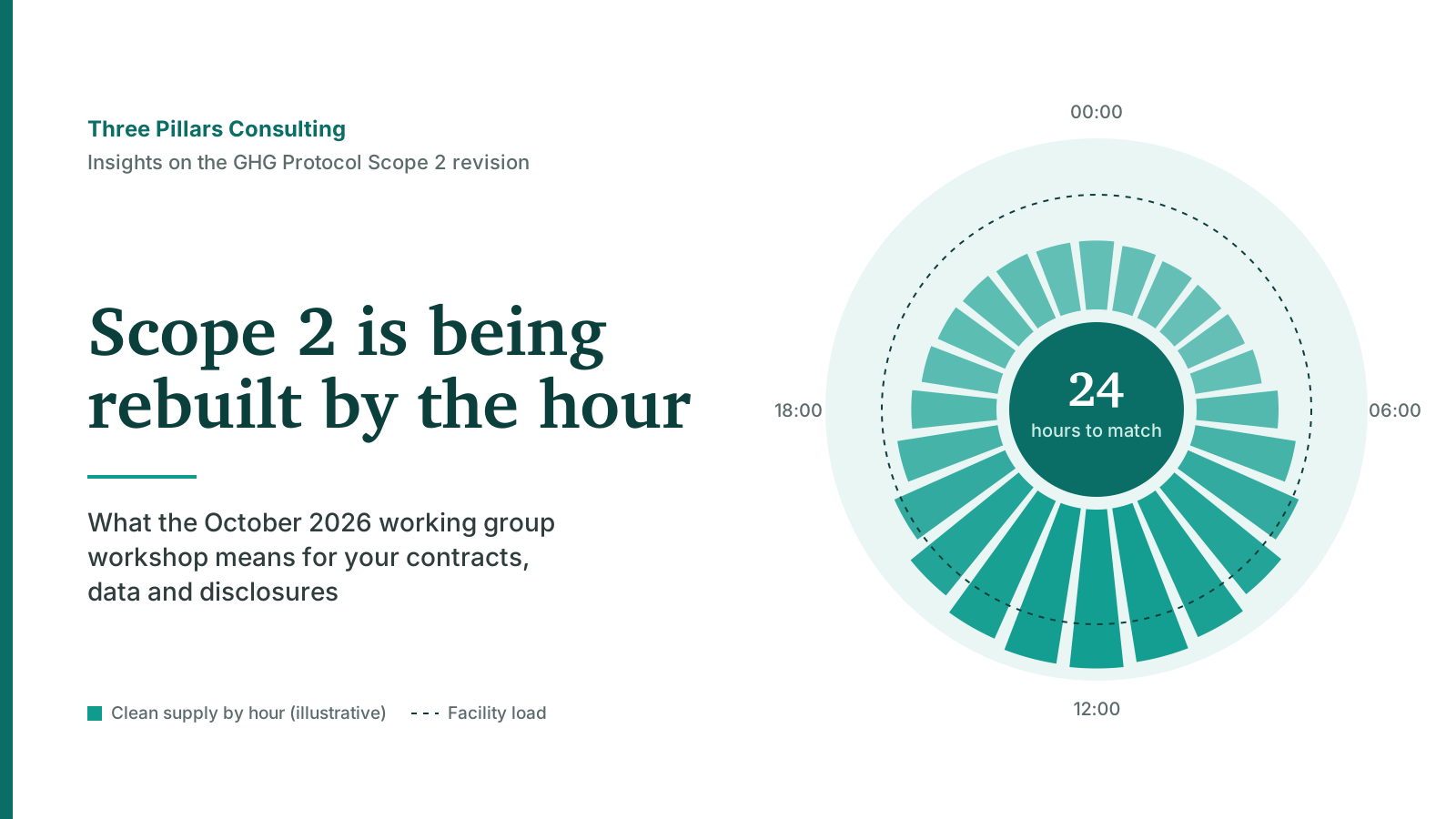
The GHG Protocol’s Scope 2 Technical Working Group met in Washington, DC, and online October 20–22. It left with a single direction rather than competing proposals. That direction has four parts. First, an improved location-based method built on a ranked hierarchy of emission factors. Second, a market-based method grounded in hourly matching and physical deliverability. Third, consequential “GHG impact” metrics reported separately from the inventory. Fourth, key indicators such as an hourly carbon-free energy matching score. Incrementality, meaning procurement from new clean generation, would be recommended rather than required, but companies would have to disclose what share of their procurement is incremental. Nothing is final yet. The working group meets again November 23–24, the Independent Standards Board votes December 15, and a consolidated public consultation draft, reviewed in parallel by ISO, follows in Q2 2027. That leaves a short window for companies to shape the outcome and prepare for it.
The most pressing decisions concern contracts. There would be no separate legacy clause. Instead, existing contracts could be reported under the 2015 rules until a cutoff somewhere between 2035 and 2039. After that, instruments must meet the new tests, or their benefit moves to the impact statement and key indicators. The working group’s leading definition of incrementality is being the original offtaker on a long-term contract, or buying from an asset within roughly 15 years of commissioning. Virtual PPAs that cross the new deliverability boundaries look most exposed. Grid context matters too. In one example from the workshop, a company matching 60% of its load on a 90% clean grid could report 60% or 96% carbon-free, depending on a fallback-rate rule the group has not yet settled. The proposed phase-in is tiered by load: companies using more than 10 TWh would start in 2031 (on 2030 data), with smaller users following in 2033 and 2035.
The regulatory overlap is also complicated. Members split evenly, 15 to 15, on whether market-based reporting should be required or only recommended, the same split ISO’s working group has reached. The standard is also converging with ISO 14064-1. Disclosure regimes built on GHG Protocol accounting, such as ISSB and ESRS, will inherit whatever emerges, while target-setting programs like SBTi and RE100 will decide their own treatment of legacy contracts. Our advice is to stress-test your PPA portfolio against the likely incrementality and deliverability tests now, build an hourly-data roadmap matched to your load tier, and engage before the consultation draft hardens. Companies that wait for the final text will be planning around rules someone else shaped.