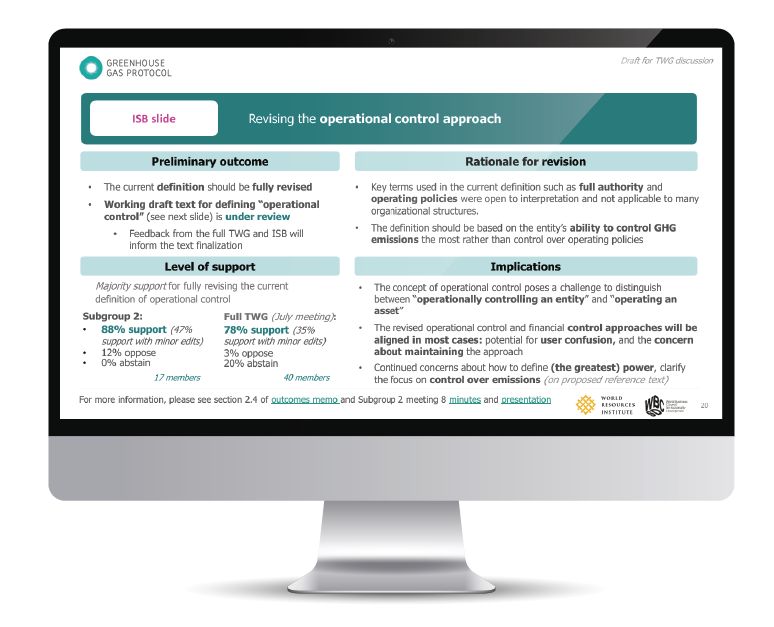
<p><span style="color: rgba(0, 0, 0, 0.9);">The proposed draft suggests moving away from linking operational control to subsidiaries, an approach that has often created ambiguity and the sense of a never-ending cascade of subsidiaries and affiliates being pulled into boundaries. Instead, the emphasis could shift toward whether the reporting company has the power to direct, implement, or influence day-to-day policies and processes.</span></p><p><br></p><p><span style="color: rgba(0, 0, 0, 0.9);">Why would this matter?</span></p><p><br></p><p><span style="color: rgba(0, 0, 0, 0.9);">📌It could create a more discreet (self-contained) boundary option, contrasting with a revised Financial Control boundary, which is likely to be more inclusive and holistic of an entity's entire portfolio of subsidiaries, affiliates, joint ventures, and so forth.</span></p><p><br></p><p><span style="color: rgba(0, 0, 0, 0.9);">📌It should allow companies to take a more practical approach to decarbonization. Expecting a parent company to decarbonize dozens of affiliates where it has only limited influence might not always be feasible. Sharper, entity-level boundaries may help companies focus where action is truly possible.</span></p><p><br></p><p><span style="color: rgba(0, 0, 0, 0.9);">📌Certain exceptions may still be necessary (e.g., when a subsidiary is fully dedicated to serving the parent company), but the broader principle is about clarity and practicality.</span></p><p><br></p><p><span style="color: rgba(0, 0, 0, 0.9);">🌍 From a decarbonization perspective, what ultimately matters is not just what the corporate-level emissions are, but which emissions are directly attributable to products and services provided by that company.</span></p><p><br></p><p><span style="color: rgba(0, 0, 0, 0.9);">💡Products provide a clearer lens: what goes in, what comes out, and the impacts that result from that. Unlike organizational boundaries, the product perspective sidesteps theoretical debates about control and influence. For example, if a downstream aluminum company holds a 50% share in a primary producer, the answer from the product’s perspective is obvious: primary aluminum is an input, so its proportional emissions should be included in the inventory. It doesn't matter who has influence over operations, who has equity, and/or who has control. </span></p><p><br></p><p><span style="color: rgba(0, 0, 0, 0.9);">While organizational boundaries will always remain important, product footprints offer a way to quantify carbon emissions and track decarbonization, often times in a more direct way. </span></p>
Looking for Expert Analysis?
Send us an email or schedule a call with us to discuss your
questions and needs
regarding carbon, energy, and sustainability.