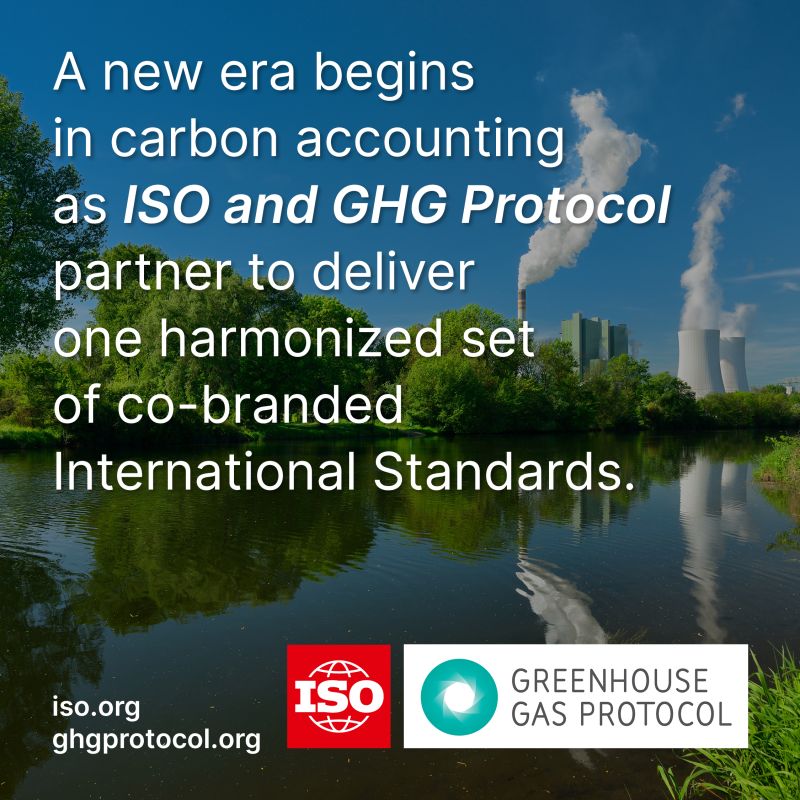
<p><span style="color: rgba(0, 0, 0, 0.9);">Just last month, </span><a href="https://www.linkedin.com/company/isostandards/?lipi=urn%3Ali%3Apage%3Ad_flagship3_feed%3BF%2B3AxSqYQluASO0GCFmfFA%3D%3D" target="_blank" style="color: rgb(0, 65, 130); background-color: rgba(0, 0, 0, 0);">ISO - International Organization for Standardization</a><span style="color: rgba(0, 0, 0, 0.9);"> and the </span><a href="https://www.linkedin.com/company/ghgprotocol/" target="_blank" style="color: rgb(10, 102, 194); background-color: rgba(0, 0, 0, 0);">Greenhouse Gas Protocol (GHG Protocol)</a><span style="color: rgba(0, 0, 0, 0.9);"> made a fairly big splash in the GHG Accounting Community by announcing their intention to co-develop and co-brand standards on Corporate Accounting as well as Product-Level Accounting.</span></p><p><br></p><p><span style="color: rgba(0, 0, 0, 0.9);">What particularly caught my eye in this announcement is the explicit mention of the co-development of a new product-level carbon accounting standard. Why? </span></p><p><br></p><p><span style="color: rgba(0, 0, 0, 0.9);">🏭 Because in a decarbonizing world, the language of climate action is no longer just about total corporate emissions. Instead, decarbonization is measured in emissions per product (or per service) across the supply chain.</span></p><p><br></p><p><span style="color: rgba(0, 0, 0, 0.9);">➡️ Regulations like CBAM and RFNBO aren't asking what your company's emissions are. They want to know your product-level emissions. The same goes for certification schemes like Aluminum Stewardship Initiative (ASI) or responding to EPD requirements in the building sector (just as a few examples). Product-level accounting is also the backbone of Scope 2 and Scope 3 accounting (which is the majority of most company's or product's emissions profile) via activity-based emissions factors.</span></p><p><br></p><p><span style="color: rgba(0, 0, 0, 0.9);">📌 I also hope the announcement by ISO and GHG-Protocol might help resolve an obvious inconsistency: the (inappropriate) use of legacy “avoided carbon credits” in corporate and product-level accounting. For example, ISO 14068 permits the use of avoidance credits, while the rest of the ISO 1406X family (and GHG Protocol) do not. </span></p><p><br></p><p><span style="color: rgba(0, 0, 0, 0.9);">📌 It is also curious to reflect on the fact that ISO does not necessarily specify the use of Scopes within their GHG accounting standards, and instead utilize Direct vs Indirect emissions (which is in agreement with the LCA community, and which I personally prefer). I suspect Scopes will stay, but a healthy debate on this might be beneficial.</span></p><p><br></p><p>You can read the official announcement from the GHG Protocol here: <a href="https://www.linkedin.com/posts/ghgprotocol_isostandards-ghgprotocol-climateaction-activity-7371029589097353216-7KGH?utm_source=share&utm_medium=member_desktop&rcm=ACoAADRv0g0BKH32cnNr3aOXTVVrH5ZMneNImMs" target="_blank">GHG Protocol LinkedIn Post</a>.</p>
Looking for Expert Analysis?
Send us an email or schedule a call with us to discuss your
questions and needs
regarding carbon, energy, and sustainability.