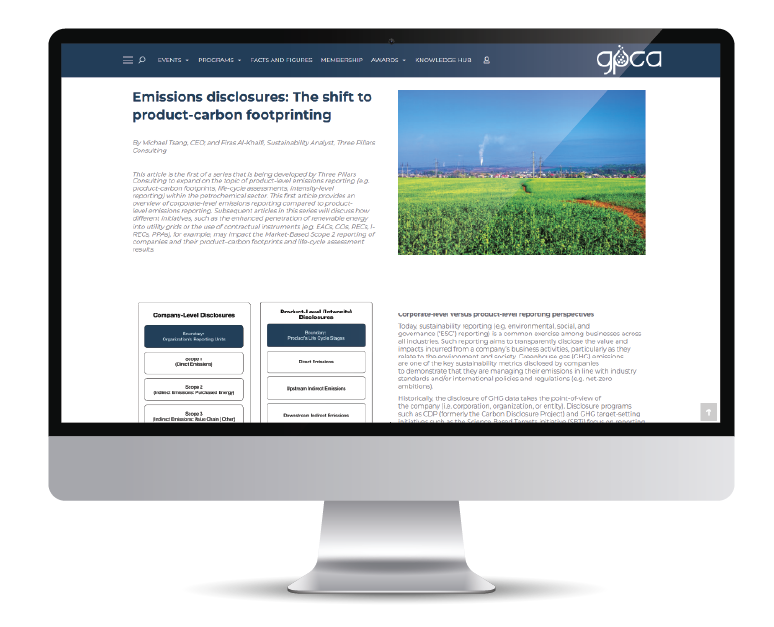
This article is the first of a series that is being developed by Three Pillars Consulting to expand on the topic of product-level emissions reporting (e.g. product-carbon footprints, life-cycle assessments, intensity-level reporting) within the petrochemical sector. This first article provides an overview of corporate-level emissions reporting compared to product-level emissions reporting. Subsequent articles in this series will discuss how different initiatives, such as the enhanced penetration of renewable energy into utility grids or the use of contractual instruments (e.g. EACs, GOs, RECs, I-RECs, PPAs), for example, may impact the Market-Based Scope 2 reporting of companies and their product–carbon footprints and life-cycle assessment results.
--------------------------------
Corporate-level versus product-level reporting perspectives
Today, sustainability reporting (e.g. environmental, social, and governance (‘ESG’) reporting) is a common exercise among businesses across all industries. Such reporting aims to transparently disclose the value and impacts incurred from a company’s business activities, particularly as they relate to the environment and society. Greenhouse gas (GHG) emissions are one of the key sustainability metrics disclosed by companies to demonstrate that they are managing their emissions in line with industry standards and/or international policies and regulations (e.g. net-zero ambitions).

Historically, the disclosure of GHG data takes the point-of-view of the company (i.e. corporation, organization, or entity). Disclosure programs such as CDP (formerly the Carbon Disclosure Project) and GHG target-setting initiatives such as the Science Based Targets initiative (SBTi) focus on reporting emissions and setting targets at the company level. In a simplified example, a company-level approach could take the total fuel, electricity, and feedstock consumption data, among other data, and convert that into Scope 1, Scope 2 and Scope 3 GHG emissions, respectively (Figure 1).

Table 1 provides a simplified example showing the GHG emissions for Company 1 and Company 2, who both make the same Product A. The results in Table 1 can support each individual company in tracking and managing its overall GHG emissions profile and ensuring they are reducing their emissions on an absolute basis. However, the results in Table 1 are not necessarily useful for benchmarking two or more companies against one another. The results in Table 1, for example, could lead to the conclusion that Company 1 is preferable over Company 2 from an emissions perspective.

Table 2 extends the example from Table 1 by disclosing the total output of Product A from each company. After normalizing the total emissions by the production output of each company, the results now show that Company 2 has lower GHG emissions per unit of production compared to Company 1. The normalization of the emissions (i.e. ratio of emissions to output) are commonly referred to as product-level accounting, intensity-level accounting, product-carbon footprinting, carbon intensities, or life-cycle assessments.
This distinction is important because many business practices and purchasing decisions occur at the product level, such as whether an input (e.g. fuels, feedstocks and ancillary materials) to a manufacturing process has the designed technical performance, physical properties, as well as cost. However, such inputs are now being increasingly evaluated based on their emissions intensity (and sustainability attributes) as a key evaluation criterion for procurement (e.g. so-called “green” procurement practices). As a result, suppliers with lower product-level emissions intensities may gain preferential access to certain markets, customers, or contracts, even if their total corporate emissions remain comparatively higher.
The shifting reporting landscape

As discussed above, GHG reporting is split between company-level and product-level disclosures. The GHG Protocol Corporate Standard and ISO 14064-1, for example, are designed to quantify and report a company’s emissions inventory (i.e. Scope 1, Scope 2, and often Scope 3), anchored in the company’s specified organizational boundaries (e.g. equity-share versus control approaches). By contrast, the GHG Protocol Product Standard and ISO 14067 – which in itself is based on the standards of life-cycle assessment (LCA) such as ISO 14040 and ISO 14044 – quantify the product-carbon footprint (PCF) across defined life-cycle stages (Figure 2), anchored in a functional unit (e.g. tons of product), system boundary (e.g. cradle-to-gate, cradle-to-grave), and allocation rules (i.e. partitioning emissions across multiple products in a multi-product production facility), among other assessment parameters.
A key distinction between company-level disclosures and PCFs is that Scope 3 emissions reporting is optional for company-level reporting. However, for PCFs and LCAs, the reporting of materially significant upstream emissions, such as the embodied emissions of input materials (e.g. feedstocks) has always been a requirement under standards such as ISO 14040, ISO 14044, or ISO 14067.
PCFs and LCAs have historically been conducted on a voluntary basis. This is most notable for companies that produce materials for the construction and building sector (e.g. steel, aluminium, cement). This is because Environmental Product Declarations (‘EPDs’), which are a type of LCA, are a requirement for many projects that need to satisfy voluntary certification programs such as the US Green Building Council’s Leadership in Energy and Environmental Design (LEED).
As the use of PCFs has increased in recent years, more attention has been placed on the standards and methods in context of ensuring that results can be comparable. A recent catalyst to streamline this work was the announcement in late 2025 by the GHG Protocol and ISO on the joint development of a new product-level GHG accounting standard, reflecting market demand for consistently applied product-level accounting methods.
Nonetheless, developments such as the forthcoming joint GHG Protocol and ISO product-level standard are product agnostic. Therefore, industry-led and sector-led initiatives (e.g. standards, methods, and certifications) will likely continue to be developed and maintained independently. For example, in the fertilizer sector, there is the Ammonia Energy Association’s (AEA) Ammonia Certification System (ACS), the forthcoming Verified Ammonia Carbon Intensity (VACI) certification program being developed by The Fertilizer Institute’s, and Ammonia Europe’s (in coordination with The Fertilizer Institute’s) Ammonia Certification Scheme.

Other industry groups in the petrochemical sector, such as The International Methanol Producers and Consumers Association, have released a “Methanol Product Carbon Footprint and Certification Guidance Document” to help companies navigate the various methodologies and certification pathways for the carbon intensities of methanol. The Methanol Institute, for example, commissioned a PCF study on methanol (Table 3) in order to (i) evaluate the differences between production pathways (i.e. technology options) and products (i.e. product types and use cases), (ii) establish sector-specific baselines and credible reference values, and (iii) provide a clearer understanding of how methods influence the outputs of a PCF study.
As demonstrated in Table 3, PCF outcomes will vary notably depending on the boundaries of the assessment (including end-of-life considerations of inventory flows), allocation of inventory data (and emissions) to co-products (including wastes), and the handling of biogenic carbon stocks within a product and the product’s life-cycle.
From voluntary to compliance-based disclosures
More recently, product-level emissions have begun to appear in compliance-oriented regulations, which is a significant departure from historically voluntary reporting. The most notable example of this is the European Union’s (EU) Carbon Border Adjustment Mechanism (CBAM), which requires that products manufactured outside of the EU, but imported into the EU, are accompanied by a disclosure of the GHG emissions incurred during the manufacturing process and/or its other life-cycle-based emissions.
Specifically, EU importers must declare the “embedded emissions” of each shipment and then surrender CBAM certificates in a quantity that corresponds to those embedded emissions, whereby the certificate price mirrors the EU ETS allowance price (i.e. Euros per ton of GHG of embedded emissions).
Embedded emissions are split into direct emissions (e.g. fuel combustion and/or process-related emissions at the producing installation) and indirect emissions, which within CBAM’s methodology refers to emissions from purchased electricity used to produce the good as well as the embedded-emissions from relevant precursor materials for certain “complex goods”.
Currently, CBAM covers the primary products of iron / steel, aluminium (aluminum), cement, cross-border electricity, hydrogen, and fertilizers. And thus, CBAM is immediately relevant to non-EU producers of fertilizers like ammonia, which are then imported into the EU.
For petrochemical companies in the Gulf Cooperation Council (GCC), exporting to the EU could translate into higher carbon-related border costs at the border, leading to tougher commercial negotiations. However, there is opportunity to implement credible, installation-level verification plus emissions mitigation projects (e.g. energy efficiency, renewable energy, fuel blending, point source carbon capture, etc.) to ensure sustained compliance and longer-term competitiveness for off-takers that demand lower-emissions or near-zero emissions products.
-----------------------------------
The next article in this series will focus on the impact that electricity-based emissions have on the PCF of petrochemical products, including (i) the current emissions intensity of electricity production and electricity grids in the GCC, (ii) the plans in GCC countries to mitigate the emissions of those grids, and (iii) the impact grid mitigation activities could have on petrochemical producers in the GCC (particularly in context of regulations like CBAM).